

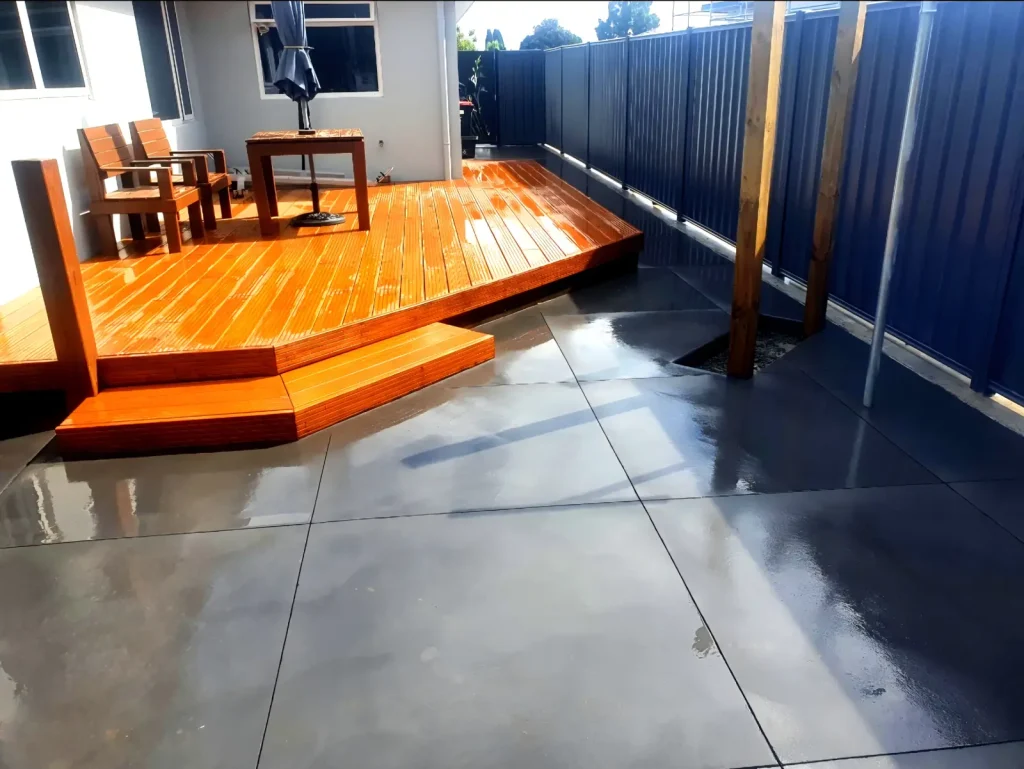
Choosing between concrete and pavers is one of the biggest decisions homeowners make when upgrading their driveway, patio or outdoor entertaining area.
Both options can look fantastic, but they each have their own advantages depending on your budget, maintenance expectations and the overall style of your home.
At Team RPM – Property Maintenance Specialists, we install both concrete and paving throughout Hawke’s Bay, and one of the most common questions we get asked is:
“Which one is actually better?”
The answer depends on your budget, the look you’re trying to achieve and how much ongoing maintenance you’re happy to do.
| Feature | Concrete | Pavers |
| Initial Cost | Generally lower | Generally higher |
| Expected Performance | Can last 20+ years with correct installation and maintenance* | Can last 20+ years with correct installation and maintenance* |
| Maintenance | Low | Moderate |
| Weed Growth | None | Possible between joints |
| Repairs | More difficult to repair invisibly | Individual pavers can be lifted and replaced |
| Design Options | Colours, exposed aggregate, decorative saw cuts, borders | Wide range of colours, textures and laying patterns |
| Installation Time | Generally quicker | Usually takes longer |
| Best Suited For | Driveways, patios, paths and parking areas | Courtyards, feature areas, patios and decorative entrances |
The lifespan of both concrete and pavers depends on site preparation, soil conditions, drainage, ground movement, tree roots, weather events, traffic loads and ongoing maintenance.
Concrete remains one of the most popular choices throughout Hawke’s Bay because it offers a clean, modern appearance while requiring very little ongoing maintenance.
Pavers provide a premium appearance and allow for greater design flexibility.
However, pavers generally require more maintenance, with occasional weed control and replenishing of jointing sand over time.
Generally speaking, concrete is the more cost-effective option, particularly over larger areas such as driveways.
Every paving project is different.
The final cost depends on:
For this reason, Team RPM provides tailored quotations for every paving project rather than publishing standard rates.
Both concrete and pavers can last 20 years or more when installed correctly and properly maintained.
However, there is no guaranteed lifespan for either product, as their longevity depends on a number of factors, including:
Here in Hawke’s Bay, we regularly experience ground movement, seasonal weather changes and significant weather events that can affect any hard surface over time.
Whether you choose concrete or pavers, the preparation beneath the finished surface is one of the biggest factors in how well it performs. Investing in proper site preparation from the outset will help maximise the life of your new driveway or patio.
Concrete generally requires:
Pavers may require:
If you’re looking for:
Concrete is often the preferred option.
If you’re wanting a premium decorative finish with greater design flexibility, paving may be the better choice.
Every property is different, which is why we always recommend discussing your project before making a final decision.
Whether you choose concrete or pavers, the most important part of the project is what lies beneath the surface.
Correct excavation, compaction, drainage and a well-prepared base all play a major role in the long-term performance of your new driveway or patio. While quality workmanship gives your project the best possible start, factors such as ground movement, tree roots and severe weather events can affect any hard surface over time.
Choosing an experienced contractor who doesn’t cut corners during the preparation stage is one of the best investments you can make.
Whether you’re considering a new driveway, patio, pathway or outdoor entertaining area, Team RPM can help you choose the right solution for your property and budget.
We take the time to assess your site, discuss your ideas and recommend the most suitable option based on your property’s conditions—not just what’s cheapest.
If you’re ready to transform your outdoor space, contact Team RPM – Property Maintenance Specialists for a free, no-obligation quote. We proudly service Hastings, Napier, Havelock North and the wider Hawke’s Bay region.
Concrete is a natural product and some movement or cracking can occur over time due to factors beyond anyone's control, including:
Control joints (saw cuts) are installed where appropriate to help manage natural movement. While every care is taken during installation, no contractor can guarantee that concrete will remain free from cracks.
No.
As a general guide:
Longer curing times may be recommended depending on weather conditions and the type of concrete installed.
Yes, they can.
Weeds can grow in the joints over time if they are not maintained.
Regular sweeping, topping up jointing sand where required and occasional weed treatment will help keep paved areas looking their best.
Yes.
Exposed aggregate requires additional materials and finishing processes, making it more expensive than standard concrete. It remains one of the most popular premium finishes because of its durability, slip resistance and decorative appearance.
Over time, all coloured concrete will naturally weather due to UV exposure and normal use. Applying a quality sealer and carrying out routine maintenance can help preserve its appearance.
Yes.
One of the advantages of paving is that individual pavers can often be lifted and replaced without removing the entire paved area, making localised repairs easier than with concrete.